

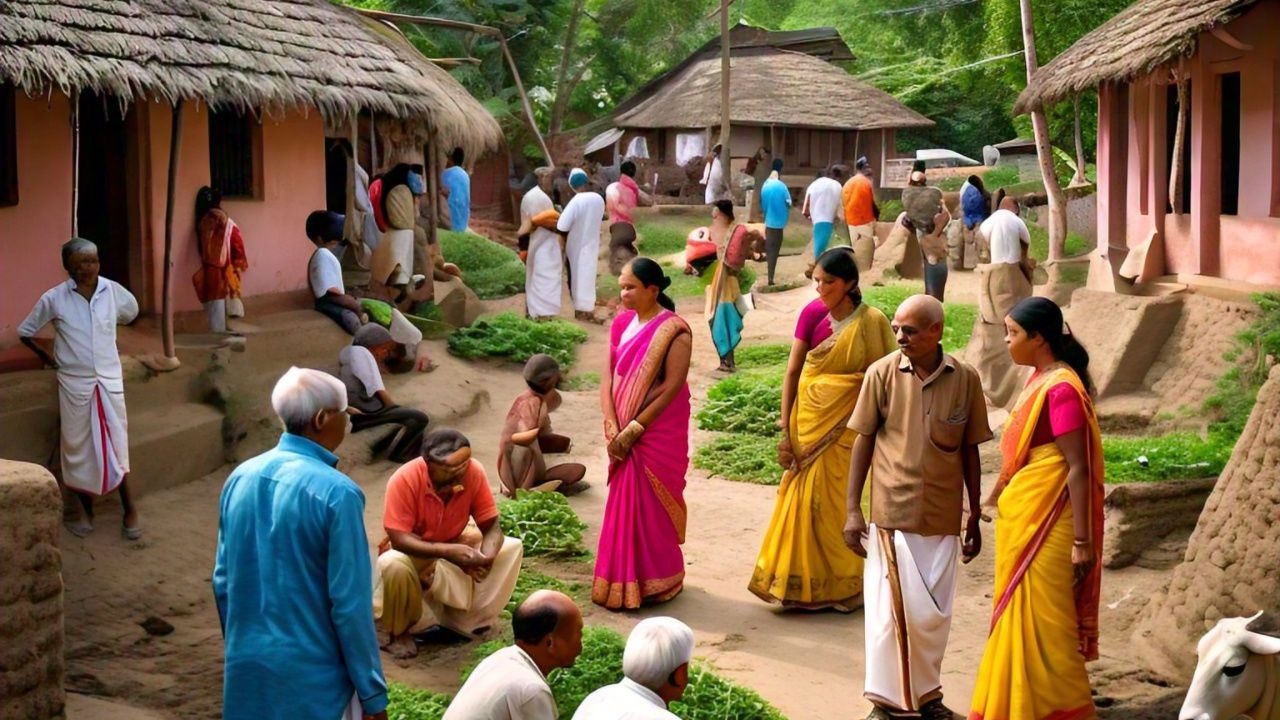
What is wrong with Indian villages?
Much of India’s landscape is dotted with villages. A big chunk of India’s population, almost _ percent, live and work in the villages. This figure corresponds with the fact that almost _ percent of the Indian population is engaged in agriculture.
While agriculture employs the bulk of the Indian population, its share in the gross development product(GDP) of the nation is much less. Instead, the manufacturing and services sector take the credit of much of India’s GDP, almost _ Percent.
As a consequence, the share of the village population in the nation’s annual wealth generation is less than that of the nation’s urban population. Because of this, India’s villages may have issues when it comes to financing their development and upliftment.
Whenever a person logs into Google Maps and zooms in closely to observe an Indian village, he is likely to witness a pleasant light all he or she is likely to see is a complete mash-up of congested rural houses abutting narrow and binding laws and alleys. Seldom does one observe any parks. Town planning is virtually zero and the villages appear to have followed the same pattern for hundreds of years.
The complete lack of systematic urban planning in villages is detrimental to the social and economic lives of villagers. Indian villages suffer from a poor quality of life. Sanitation and health problems are rampant. Furthermore, even individual houses suffer from rampant indoor pollution due to ‘Chulhas’.
Another major problem in Indian villages that has been exacerbated by the absence of urban planning is social stratification and gentrification based on caste. Different castes unfortunately tend to reside in different areas, with areas inhabited by people from the lower castes, being at the receiving end of all kinds of problems. Such as poor infrastructure and sanitation. It is needless to add that caste conflicts also exist, albeit on a shorter scale today vis-a-vis the past.
How to expedite the Remodelling of Indian Villages?
- Let me offer a path-breaking solution- demolish the Indian village structures (Namely its built-up area).
- Once the built-up areas are demolished, the newly vacated land plots should be pooled and amalgamated all boundaries (pre-existing) should be erased.
- Thereafter the pooled and amalgamated land should be laid out in a gridiron framework with roads inter-setting at 90-degree angles. In short, Chandigarh-style planning should be implemented, at least at a lower scale.
- Once the grid-iron style lying out and plotting is done, the green spaces parks, jogging tracks, and sports fields and designated. It is my frank and honest opinion that a minimum of 30% and a maximum of 40% to 50% of the total grace layout area must be reserved for recreation and green areas. Once the green areas are demarcated and designated the balance layout area (net of roads) must be zoned into residential, commercial, cottage industry/light industry, educational healthcare, and socio-cultural areas. Residential areas can be built up with multi-story apartment blocks, much of the lives of public housing in Singapore.
- Taking inspiration from Singapore people of different castes, authenticity, religions, and communities should be allocated flats/apartments in the same building. This will go a long way in preventing the emergence of “Ghettas”.
- Likewise, schools, colleges, hospitals, and medical clinics should be established in the respective areas designated for them. The planning should be such that they are easily accessible from the residential areas. The curriculum flattered in the schools should preferably be C.B.S.E. (Central Board Of Secondary Education). This will ensure uniform standards of quality vis-a-vis private schools.
- Fill measures suggested in this article are likely to be in vain unless substantial steps are taken for the socio-cultural upliftment of the people. The biggest enemy of the Indian country at large is “Gawaarpan”. The rustic mindset of vernacular people has urged havoc on India’s socio-cultural.
- Progress since independence stringent steps must be taken to curb the tendency of people to revert to their lease rustic and ‘Gawaar’ nature.
Let me be further frank and open about this Gawaarpan was never a part of ancient Indian scriptures, which were written in highly polished Sanskrit ‘Shudh’ Hindi also has little or no space for rustic vernacular language. A detailed investigation and introspection need to be done on how the Gawaarpan gang embedded itself so deeply into the vernacular native Indian mindset.
Finally, impieties must be given to the establishment of performing arts venues in Indian villages this will give villagers an outlet for their creative and artistic abilities innovation centers and ‘maker space’ laboratories should also be constructed to encourage the innovative abilities of people to take a leaf of inspiration from the Indian Gugaad spirit.